Nitrogen fixation is a process by which molecular nitrogen in the air is converted into ammonia (NH
3) or related nitrogenous compounds in soil.[1] Atmospheric nitrogen is molecular dinitrogen, a relatively nonreactive molecule that is metabolically useless to all but a few microorganisms. Biological nitrogen fixation converts N
2 into ammonia, which is metabolized by most organisms.
Nitrogen fixation is essential to life because fixed inorganic nitrogen compounds are required for the biosynthesis of all nitrogen-containing organic compounds, such as amino acids and proteins, nucleoside triphosphates and nucleic acids. As part of the nitrogen cycle, it is essential for agriculture and the manufacture of fertilizer. It is also, indirectly, relevant to the manufacture of all nitrogen chemical compounds, which includes some explosives, pharmaceuticals, and dyes.
Nitrogen fixation is carried out naturally in soil by microorganisms termed diazotrophs that include bacteria such as Azotobacter and archaea. Some nitrogen-fixing bacteria have symbiotic relationships with plant groups, especially legumes.[2] Looser non-symbiotic relationships between diazotrophs and plants are often referred to as associative, as seen in nitrogen fixation on rice roots. Nitrogen fixation occurs between some termites and fungi.[3] It occurs naturally in the air by means of NOx production by lightning.[4][5]
All biological reactions involving the process of nitrogen fixation are catalysed by enzymes called nitrogenases.[6] These enzymes contain iron, often with a second metal, usually molybdenum but sometimes vanadium.
Fixation
Non-biological
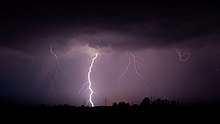
2 starting the formation of nitrous acid.
Nitrogen can be fixed by lightning that converts nitrogen gas (N
2) and oxygen gas (O
2) present in the atmosphere into NO
x (nitrogen oxides). NO
x may react with water to make nitrous acid or nitric acid, which seeps into the soil, where it makes nitrate, which is of use to plants. Nitrogen in the atmosphere is highly stable and nonreactive due to the triple bond between atoms in the N
2 molecule.[7] Lightning produces enough energy and heat to break this bond[7] allowing nitrogen atoms to react with oxygen, forming NO
x. These compounds cannot be used by plants, but as this molecule cools, it reacts with oxygen to form NO
2.[8] This molecule in turn reacts with water to produce HNO
3 (nitric acid), or its ion NO−
3 (nitrate), which is usable by plants.[9][7]
Biological
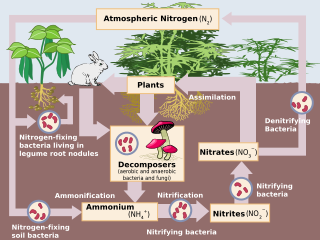
Biological nitrogen fixation was discovered by Jean-Baptiste Boussingault in 1838.[10] Later, in 1880, the process by which it happens was discovered by German agronomist Hermann Hellriegel and Hermann Wilfarth[11] and was fully described by Dutch microbiologist Martinus Beijerinck.[12]
"The protracted investigations of the relation of plants to the acquisition of nitrogen begun by Saussure, Ville, Lawes and Gilbert and others culminated in the discover of symbiotic fixation by Hellriegel and Wilfarth in 1887."[13]
"Experiments by Bossingault in 1855 and Pugh, Gilbert & Lawes in 1887 had shown that nitrogen did not enter the plant directly. The discovery of the role of nitrogen fixing bacteria by Herman Hellriegel and Herman Wilfarth in 1886-8 would open a new era of soil science."[14]
In 1901 Beijerinck showed that azotobacter chroococcum was able to fix atmospheric nitrogen. This was the first species of the azotobacter genus, so-named by him. It is also the first known diazotroph, the species that use diatomic nitrogen as a step in the complete nitrogen cycle.
Biological nitrogen fixation (BNF) occurs when atmospheric nitrogen is converted to ammonia by a nitrogenase enzyme.[1] The overall reaction for BNF is:


The process is coupled to the hydrolysis of 16 equivalents of ATP and is accompanied by the co-formation of one equivalent of H
2.[15] The conversion of N
2 into ammonia occurs at a metal cluster called FeMoco, an abbreviation for the iron-molybdenum cofactor. The mechanism proceeds via a series of protonation and reduction steps wherein the FeMoco active site hydrogenates the N
2 substrate.[16] In free-living diazotrophs, nitrogenase-generated ammonia is assimilated into glutamate through the glutamine synthetase/glutamate synthase pathway. The microbial nif genes required for nitrogen fixation are widely distributed in diverse environments.[17]
For example decomposing wood which has generally low content of nitrogen was shown to host diazotrophic community.[18][19] Bacteria through fixation enrich wood substrate with nitrogen thus enabling deadwood decomposition by fungi.[20]
Nitrogenases are rapidly degraded by oxygen. For this reason, many bacteria cease production of the enzyme in the presence of oxygen. Many nitrogen-fixing organisms exist only in anaerobic conditions, respiring to draw down oxygen levels, or binding the oxygen with a protein such as leghemoglobin.[1]
Microorganisms
Diazotrophs are widespread within domain Bacteria including cyanobacteria (e.g. the highly significant Trichodesmium and Cyanothece), as well as green sulfur bacteria, Azotobacteraceae, rhizobia and Frankia. Several obligately anaerobic bacteria fix nitrogen including many (but not all) Clostridium spp. Some archaea also fix nitrogen, including several methanogenic taxa, which are significant contributors to nitrogen fixation in oxygen-deficient soils.[21]
Cyanobacteria inhabit nearly all illuminated environments on Earth and play key roles in the carbon and nitrogen cycle of the biosphere. In general, cyanobacteria can use various inorganic and organic sources of combined nitrogen, such as nitrate, nitrite, ammonium, urea, or some amino acids. Several cyanobacteria strains are also capable of diazotrophic growth, an ability that may have been present in their last common ancestor in the Archean eon.[22] Nitrogen fixation by cyanobacteria in coral reefs can fix twice as much nitrogen as on land—around 660 kg/ha/year. The colonial marine cyanobacterium Trichodesmium is thought to fix nitrogen on such a scale that it accounts for almost half of the nitrogen fixation in marine systems globally.[23]
Marine surface lichens and non-photosynthetic bacteria belonging in Proteobacteria and Planctomycetes fixate significant atmospheric nitrogen.[24]
Root nodule symbioses
Legume family
Plants that contribute to nitrogen fixation include those of the legume family—Fabaceae— with taxa such as kudzu, clover, soybean, alfalfa, lupin, peanut and rooibos. They contain symbiotic rhizobia bacteria within nodules in their root systems, producing nitrogen compounds that help the plant to grow and compete with other plants.[25] When the plant dies, the fixed nitrogen is released, making it available to other plants; this helps to fertilize the soil.[1][26] The great majority of legumes have this association, but a few genera (e.g., Styphnolobium) do not. In many traditional farming practices, fields are rotated through various types of crops, which usually include one consisting mainly or entirely of clover.[citation needed]
Fixation efficiency in soil is dependent on many factors, including the legume and air and soil conditions. For example, nitrogen fixation by red clover can range from 50 to 200 lb./acre.[27]
Non-leguminous
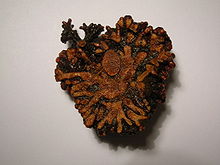
Other nitrogen fixing families include:
- Parasponia, a tropical genus in the family Cannabaceae, which are able to interact with rhizobia and form nitrogen-fixing nodules[28]
- Actinorhizal plants such as alder and bayberry can form nitrogen-fixing nodules, thanks to a symbiotic association with Frankia bacteria. These plants belong to 25 genera[29] distributed across eight families.
The ability to fix nitrogen is present in other families that belong to the orders Cucurbitales, Fagales and Rosales, which together with the Fabales form a clade of eurosids. The ability to fix nitrogen is not universally present in these families. For example, of 122 Rosaceae genera, only four fix nitrogen. Fabales were the first lineage to branch off this nitrogen-fixing clade; thus, the ability to fix nitrogen may be plesiomorphic and subsequently lost in most descendants of the original nitrogen-fixing plant; however, it may be that the basic genetic and physiological requirements were present in an incipient state in the most recent common ancestors of all these plants, but only evolved to full function in some of them.
Several nitrogen-fixing symbiotic associations involve cyanobacteria (such as Nostoc):
- Some lichens such as Lobaria and Peltigera
- Mosquito fern (Azolla species)
- Cycads
- Gunnera
- Blasia (liverwort)
- Hornworts[30]
Endosymbiosis in diatoms
Rhopalodia gibba, a diatom alga, is a eukaryote with cyanobacterial N
2-fixing endosymbiont organelles. The spheroid bodies reside in the cytoplasm of the diatoms and are inseparable from their hosts.[31][32]
Eukaryotic Nitrogenase Engineering
Some scientists are working towards introducing the genes responsible for nitrogen fixation directly into plant DNA. As all known examples of nitrogen fixation takes place in prokaryotes, transferring the functionality to eukaryotes such as plant is a challenge; one team is using yeast as their eukaryotic test organism. A major problem to overcome is the oxygen-sensitivity of the produced enzymes, as well as the energy requirements. Having the process taking place inside of mitocondria or chloroplasts is being considered.[33]
Industrial processes
The possibility that atmospheric nitrogen reacts with certain chemicals was first observed by Desfosses in 1828. He observed that mixtures of alkali metal oxides and carbon react at high temperatures with nitrogen. With the use of barium carbonate as starting material, the first commercial process became available in the 1860s, developed by Margueritte and Sourdeval. The resulting barium cyanide could be reacted with steam yielding ammonia.
History
Prior to 1900, Tesla experimented with industrial nitrogen fixation "by using currents of extremely high frequency or rate of vibration".[34][35]
Frank-Caro process
In 1898 Frank and Caro decoupled the process and produced calcium carbide and in a subsequent step reacted it with nitrogen to calcium cyanamide. The Ostwald process for the production of nitric acid was discovered in 1902. The Frank-Caro and Ostwald processes dominated industrial fixation until the discovery of the Haber process in 1909.[36][37]
Haber process

The most common ammonia production method is the Haber process. Fertilizer production is now the largest source of human-produced fixed nitrogen in the terrestrial ecosystem. Ammonia is a required precursor to fertilizers, explosives, and other products. The Haber process requires high pressures (around 200 atm) and high temperatures (at least 400 °C), which are routine conditions for industrial catalysis. This process uses natural gas as a hydrogen source and air as a nitrogen source.[38]
Much research has been conducted on the discovery of catalysts for nitrogen fixation, often with the goal of reducing energy requirements. However, such research has thus far failed to approach the efficiency and ease of the Haber process. Many compounds react with atmospheric nitrogen to give dinitrogen complexes. The first dinitrogen complex to be reported was Ru(NH
3)
5(N
2)2+.[39]
Ambient nitrogen reduction
Achieving catalytic chemical nitrogen fixation at ambient conditions is an ongoing scientific endeavor. Guided by the example of nitrogenase, this area of homogeneous catalysis is ongoing, with particular emphasis on hydrogenation.[40]
Metallic lithium burns in an atmosphere of nitrogen and then converts to lithium nitride. Hydrolysis of the resulting nitride gives ammonia. In a related process, trimethylsilyl chloride, lithium and nitrogen react in the presence of a catalyst to give tris(trimethylsilyl)amine. This can then be used for reaction with α,δ,ω-triketones to give tricyclic pyrroles.[41] Processes involving lithium metal are however of no practical interest since they are non-catalytic and re-reducing the Li+
ion residue is difficult.
Beginning in the 1960s several homogeneous systems were identified that convert nitrogen to ammonia, sometimes catalytically, but often operating via ill-defined mechanisms. The original discovery is described in an early review:
"Vol'pin and co-workers, using a non-protic Lewis acid, aluminium tribromide, were able to demonstrate the truly catalytic effect of titanium by treating dinitrogen with a mixture of titanium tetrachloride, metallic aluminium, and aluminium tribromide at 50 °C, either in the absence or in the presence of a solvent, e.g. benzene. As much as 200 mol of ammonia per mol of TiCl
4 was obtained after hydrolysis.…"[42]

The quest for well-defined intermediates led to the characterization of many transition metal dinitrogen complexes. While few of these well-defined complexes function catalytically, their behavior illuminated likely stages in nitrogen fixation. Fruitful early studies focused on (MN20−
2)(dppe)2 (M = Mo, W), which protonates to give intermediates with ligand M=N−N
2. In 1995, a molybdenum(III) amido complex was discovered that cleaved N
2 to give the corresponding molybdenum (VI) nitride.[44] This and related terminal nitrido complexes have been used to make nitriles.[45]
In 2003 a molybdenum amido complex was found to catalyze the reduction of N
2, albeit with few turnovers.[43][46][47][48] In these systems, like the biological one, hydrogen is provided to the substrate heterolytically, by means of protons and a strong reducing agent rather than with H
2.
In 2011, another molybdenum-based system was discovered, but with a diphosphorus pincer ligand.[49] Photolytic nitrogen splitting is also considered.[50][51][52][53][54]

Nitrogen fixation at a p-block element was published in 2018 whereby one molecule of dinitrogen is bound by two transient Lewis-base-stabilized borylene species.[55] The resulting dianion was subsequently oxidized to a neutral compound, and reduced using water.
Photochemical and electrochemical nitrogen reduction
With the help of catalysis and energy provided by electricity and light, NH
3 can be produced directly from nitrogen and water at ambient temperature and pressure.[citation needed]
This article uses material from the Wikipedia article
Metasyntactic variable, which is released under the
Creative Commons
Attribution-ShareAlike 3.0 Unported License.
Metasyntactic variable, which is released under the
Creative Commons
Attribution-ShareAlike 3.0 Unported License.