Metabolic network

 A metabolic network is the complete set of metabolic and physical processes that determine the physiological and biochemical properties of a cell. As such, these networks comprise the chemical reactions of metabolism, the metabolic pathways, as well as the regulatory interactions that guide these reactions.

With the sequencing of complete genomes, it is now possible to reconstruct the network of biochemical reactions in many organisms, from bacteria to human. Several of these networks are available online: Kyoto Encyclopedia of Genes and Genomes (KEGG),[1] EcoCyc,[2] BioCyc[3] and metaTIGER.[4] Metabolic networks are powerful tools for studying and modelling metabolism.
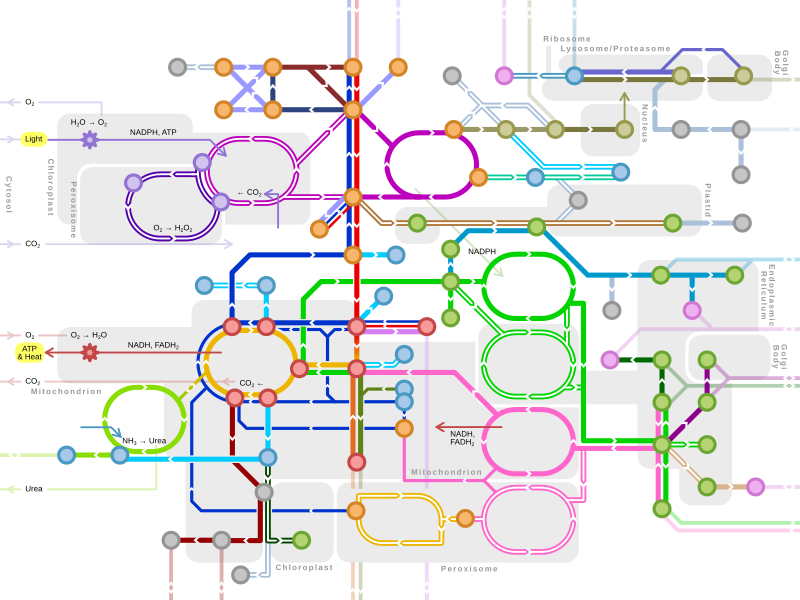

Metro-style map of major metabolic pathways
Carbon
fixation
Photo-
respiration
Pentose
phosphate
pathway
Citric
acid cycle
Glyoxylate
cycle
Urea
cycle
Fatty
acid
synthesis
Fatty
acid
elongation
Beta
oxidation
Peroxisomal
beta
oxidation


Glyco-
genolysis
Glyco-
genesis
Glyco-
lysis
Gluconeo-
genesis
Pyruvate
decarb-
oxylation
Fermentation
Keto-
lysis
Keto-
genesis
feeders to
gluconeo-
genesis
Direct / C4 / CAM
carbon intake
Light reaction
Oxidative
phosphorylation
Amino acid
deamination
Citrate
shuttle
Lipogenesis
Lipolysis
Steroidogenesis
MVA pathway
MEP pathway
Shikimate
pathway
Transcription &
replication
Translation
Proteolysis
Glycosyl-
ation


Sugar
acids
Double/multiple
sugars & glycans
Simple
sugars
Inositol-P
Amino sugars
sialic acids
Nucleotide sugars
Hexose-P
Triose-P
Glycerol
P-glycerates
Pentose-P
Tetrose-P
Propionyl
-CoA
Succinate
Acetyl
-CoA
Pentose-P
P-glycerates
Glyoxylate
Photosystems
Pyruvate
Lactate
Acetyl
-CoA
Citrate
Oxalo-
acetate
Malate
Succinyl
-CoA
α-Keto-
glutarate
Ketone
bodies
Respiratory
chain
Serine group
Alanine
Branched-chain
amino acids
Aspartate
group
Homoserine
group
lysine
Glutamate
group
proline
Arginine
Creatine
polyamines
Ketogenic &
glucogenic
amino acids
Amino acids
Shikimate
Aromatic amino
acids & histidine
Ascorbate
(vitamin C)
δ-ALA
Bile
pigments
Hemes
Cobalamins (vitamin B12)
Various
vitamin Bs
Calciferols
(vitamin D)
Retinoids
(vitamin A)
Quinones (vitamin K)
carotenoids (vitamin E)
Cofactors
Vitamins
minerals
Antioxidants
PRPP
Nucleotides
Nucleic
acids
Proteins
Glycoproteins
proteoglycans
Chlorophylls
MEP
MVA
Acetyl
-CoA
Polyketides
Terpenoid
backbones
Terpenoids
carotenoids (vitamin A)
Cholesterol
Bile acids
Glycero-
phospholipids
Glycerolipids
Acyl-CoA
Fatty
acids
Glyco-
sphingolipids
Sphingolipids
Waxes
Polyunsaturated
fatty acids
Neurotransmitters
thyroid hormones
Steroids
Endo-
cannabinoids
Eicosanoids
The image above contains clickable links
Major metabolic pathways in metro-style map. Click any text (name of pathway or metabolites) to link to the corresponding article.
Single lines: pathways common to most lifeforms. Double lines: pathways not in humans (occurs in e.g. plants, fungi, prokaryotes). Metabolic metro orange.svg Orange nodes: carbohydrate metabolism. Metabolic metro purple.svg Violet nodes: photosynthesis. Metabolic metro red.svg Red nodes: cellular respiration. Metabolic metro pink.svg Pink nodes: cell signaling. Metabolic metro blue.svg Blue nodes: amino acid metabolism. Metabolic metro grey.svg Grey nodes: vitamin and cofactor metabolism. Metabolic metro brown.svg Brown nodes: nucleotide and protein metabolism. Metabolic metro green.svg Green nodes: lipid metabolism.


UsesEdit

Metabolic networks can be used to detect comorbidity patterns in diseased patients.[5] Certain diseases, such as obesity and diabetes, can be present in the same individual concurrently, sometimes one disease being a significant risk factor for the other disease.[6] The disease phenotypes themselves are normally the consequence of the cell’s inability to breakdown or produce an essential substrate. However, an enzyme defect at one reaction may affect the fluxes of other subsequent reactions. These cascading effects couple the metabolic diseases associated with subsequent reactions resulting in comorbidity effects. Thus, metabolic disease networks can be used to determine if two disorders are connected due to their correlated reactions.[5]


This article uses material from the Wikipedia article
 Metasyntactic variable, which is released under the 
Creative Commons
Attribution-ShareAlike 3.0 Unported License
.