Metabolic control analysis

 Metabolic control analysis (MCA) is a mathematical framework for describing metabolic, signaling, and genetic pathways. MCA quantifies how variables, such as fluxes and species concentrations, depend on network parameters. In particular it is able to describe how network dependent properties, called control coefficients, depend on local properties called elasticities.[1][2][3]

MCA was originally developed to describe the control in metabolic pathways but was subsequently extended to describe signaling and genetic networks. MCA has sometimes also been referred to as Metabolic Control Theory but this terminology was rather strongly opposed by Henrik Kacser, one of the founders[citation needed].

More recent work[4] has shown that MCA can be mapped directly on to classical control theory and are as such equivalent.

Biochemical systems theory[5] is a similar formalism, though with a rather different objectives. Both are evolutions of an earlier theoretical analysis by Joseph Higgins.[6]

Control coefficientsEdit

A control coefficient[7][8][9] measures the relative steady state change in a system variable, e.g. pathway flux (J) or metabolite concentration (S), in response to a relative change in a parameter, e.g. enzyme activity or the steady-state rate (v_{i}) of step i. The two main control coefficients are the flux and concentration control coefficients. Flux control coefficients are defined by:

C_{{v_{i}}}^{J}=\left({\frac  {dJ}{dp}}{\frac  {p}{J}}\right){\bigg /}\left({\frac  {\partial v_{i}}{\partial p}}{\frac  {p}{v_{i}}}\right)={\frac  {d\ln J}{d\ln v_{i}}}

and concentration control coefficients by:

C_{{v_{i}}}^{S}=\left({\frac  {dS}{dp}}{\frac  {p}{S}}\right){\bigg /}\left({\frac  {\partial v_{i}}{\partial p}}{\frac  {p}{v_{i}}}\right)={\frac  {d\ln S}{d\ln v_{i}}}

Summation theoremsEdit

The flux control summation theorem was discovered independently by the Kacser/Burns group and the Heinrich/Rapoport group in the early 1970s and late 1960s. The flux control summation theorem implies that metabolic fluxes are systemic properties and that their control is shared by all reactions in the system. When a single reaction changes its control of the flux this is compensated by changes in the control of the same flux by all other reactions.

\sum _{i}C_{{v_{i}}}^{J}=1
\sum _{i}C_{{v_{i}}}^{S}=0

Elasticity coefficientsEdit

The elasticity coefficient measures the local response of an enzyme or other chemical reaction to changes in its environment. Such changes include factors such as substrates, products or effector concentrations. For further information please refer to the dedicated page at elasticity coefficients.

Connectivity theoremsEdit

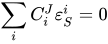
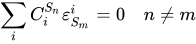
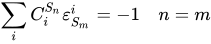
The connectivity theorems are specific relationships between elasticities and control coefficients. They are useful because they highlight the close relationship between the kinetic properties of individual reactions and the system properties of a pathway. Two basic sets of theorems exists, one for flux and another for concentrations. The concentration connectivity theorems are divided again depending on whether the system species  S_n  is different from the local species S_{m}.

\sum _{i}C_{i}^{J}\varepsilon _{S}^{i}=0
\sum _{i}C_{i}^{{S_{n}}}\varepsilon _{{S_{m}}}^{i}=0\quad n\neq m
\sum _{i}C_{i}^{{S_{n}}}\varepsilon _{{S_{m}}}^{i}=-1\quad n=m

Control equationsEdit

It is possible to combine the summation with the connectivity theorems to obtain closed expressions that relate the control coefficients to the elasticity coefficients. For example, consider the simplest non-trivial pathway:

X_{o}\rightarrow S\rightarrow X_{1}

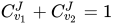
We assume that X_{o} and X_{1} are fixed boundary species so that the pathway can reach a steady state. Let the first step have a rate v_{1} and the second step v_{2}. Focusing on the flux control coefficients, we can write one summation and one connectivity theorem for this simple pathway:

C_{{v_{1}}}^{J}+C_{{v_{2}}}^{J}=1
C_{{v_{1}}}^{J}\varepsilon _{S}^{{v_{1}}}+C_{{v_{2}}}^{J}\varepsilon _{S}^{{v_{2}}}=0

Using these two equations we can solve for the flux control coefficients to yield:
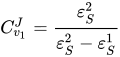
C_{{v_{1}}}^{J}={\frac  {\varepsilon _{S}^{{2}}}{\varepsilon _{S}^{{2}}-\varepsilon _{S}^{{1}}}}
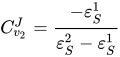
C_{{v_{2}}}^{J}={\frac  {-\varepsilon _{S}^{{1}}}{\varepsilon _{S}^{{2}}-\varepsilon _{S}^{{1}}}}

Using these equations we can look at some simple extreme behaviors. For example, let us assume that the first step is completely insensitive to its product (i.e. not reacting with it), S, then \varepsilon _{S}^{{v_{1}}}=0. In this case, the control coefficients reduce to:

C_{{v_{1}}}^{J}=1
C_{{v_{2}}}^{J}=0

That is all the control (or sensitivity) is on the first step. This situation represents the classic rate-limiting step that is frequently mentioned in text books. The flux through the pathway is completely dependent on the first step. Under these conditions, no other step in the pathway can affect the flux. The effect is however dependent on the complete insensitivity of the first step to its product. Such a situation is likely to be rare in real pathways. In fact the classic rate limiting step has almost never been observed experimentally. Instead, a range of limitingness is observed, with some steps having more limitingness (control) than others.

We can also derive the concentration control coefficients for the simple two step pathway:
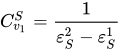
C_{{v_{1}}}^{S}={\frac  {1}{\varepsilon _{S}^{{2}}-\varepsilon _{S}^{{1}}}}
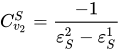
C_{{v_{2}}}^{S}={\frac  {-1}{\varepsilon _{S}^{{2}}-\varepsilon _{S}^{{1}}}}

Three step pathwayEdit

Consider the simple three step pathway:

X_{o}\rightarrow S_{1}\rightarrow S_{2}\rightarrow X_{1}

where X_{o} and X_{1} are fixed boundary species, the control equations for this pathway can be derived in a similar manner to the simple two step pathway although it is somewhat more tedious.

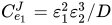
{\displaystyle C_{e_{1}}^{J}=\varepsilon _{1}^{2}\varepsilon _{2}^{3}/D}
{\displaystyle C_{e_{2}}^{J}=-\varepsilon _{1}^{1}\varepsilon _{2}^{3}/D}
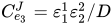
{\displaystyle C_{e_{3}}^{J}=\varepsilon _{1}^{1}\varepsilon _{2}^{2}/D}

where D the denominator is given by:

D=\varepsilon _{1}^{{2}}\varepsilon _{2}^{{3}}-\varepsilon _{1}^{{1}}\varepsilon _{2}^{{3}}+\varepsilon _{1}^{{1}}\varepsilon _{2}^{{2}}

Note that every term in the numerator appears in the denominator, this ensures that the flux control coefficient summation theorem is satisfied.

Likewise the concentration control coefficients can also be derived, for S_{1}

{\displaystyle C_{e_{1}}^{S_{1}}=(\varepsilon _{2}^{3}-\varepsilon _{2}^{2})/D}
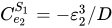
{\displaystyle C_{e_{2}}^{S_{1}}=-\varepsilon _{2}^{3}/D}
{\displaystyle C_{e_{3}}^{S_{1}}=\varepsilon _{2}^{2}/D}

And for S_{2}

{\displaystyle C_{e_{1}}^{S_{2}}=\varepsilon _{1}^{2}/D}
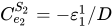
{\displaystyle C_{e_{2}}^{S_{2}}=-\varepsilon _{1}^{1}/D}
{\displaystyle C_{e_{3}}^{S_{2}}=(\varepsilon _{1}^{1}-\varepsilon _{1}^{2})/D}

Note that the denominators remain the same as before and behave as a normalizing factor.

Derivation using perturbationsEdit

Control equations can also be derived by considering the effect of perturbations on the system. Consider that reaction rates v_{1} and v_{2} are determined by two enzymes e_{1} and e_{2} respectively. Changing either enzyme will result in a change to the steady state level of x and the steady state reaction rates v. Consider a small change in e_{1} of magnitude {\displaystyle \delta e_{1}}. This will have a number of effects, it will increase v_{1} which in turn will increase x which in turn will increase v_{2}. Eventually the system will settle to a new steady state. We can describe these changes by focusing on the change in v_{1} and v_{2}. The change in v_{2}, which we designate {\displaystyle \delta v_{2}}, came about as a result of the change \delta x. Because we are only considering small changes we can express the change {\displaystyle \delta v_{2}} in terms of \delta x using the relation:

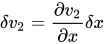
{\displaystyle \delta v_{2}={\frac {\partial v_{2}}{\partial x}}\delta x}

where the derivative {\displaystyle \partial v_{2}/\partial x} measures how responsive v_{2} is to changes in x. The derivative can be computed if we know the rate law for v_{2}. For example, if we assume that the rate law is {\displaystyle v_{2}=k_{2}x} then the derivative is k_{2}. We can also use a similar strategy to compute the change in v_{1} as a result of the change {\displaystyle \delta e_{1}}. This time the change in v_{1} is a result of two changes, the change in e_{1} itself and the change in x. We can express these changes by summing the two individual contributions:

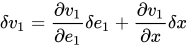
{\displaystyle \delta v_{1}={\frac {\partial v_{1}}{\partial e_{1}}}\delta e_{1}+{\frac {\partial v_{1}}{\partial x}}\delta x}

We have two equations, one describing the change in v_{1} and the other in v_{2}. Because we allowed the system to settle to a new steady state we can also state that the change in reaction rates must be the same (otherwise it wouldn't be at steady state). That is we can assert that {\displaystyle \delta v_{1}=\delta v_{2}}. With this in mind we equate the two equations and write:

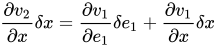
{\displaystyle {\frac {\partial v_{2}}{\partial x}}\delta x={\frac {\partial v_{1}}{\partial e_{1}}}\delta e_{1}+{\frac {\partial v_{1}}{\partial x}}\delta x}

Solving for the ratio {\displaystyle \delta x/\delta e_{1}} we obtain:

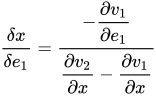
{\displaystyle {\frac {\delta x}{\delta e_{1}}}={\dfrac {-{\dfrac {\partial v_{1}}{\partial e_{1}}}}{{\dfrac {\partial v_{2}}{\partial x}}-{\dfrac {\partial v_{1}}{\partial x}}}}}

In the limit, as we make the change {\displaystyle \delta e_{1}} smaller and smaller, the left-hand side converges to the derivative {\displaystyle dx/de_{1}}:
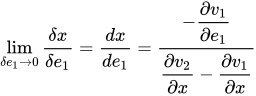
{\displaystyle \lim _{\delta e_{1}\rightarrow 0}{\frac {\delta x}{\delta e_{1}}}={\frac {dx}{de_{1}}}={\dfrac {-{\dfrac {\partial v_{1}}{\partial e_{1}}}}{{\dfrac {\partial v_{2}}{\partial x}}-{\dfrac {\partial v_{1}}{\partial x}}}}}

We can go one step further and scale the derivatives to eliminate units. Multiplying both sides by e_{1} and dividing both sides by x yields the scaled derivatives:
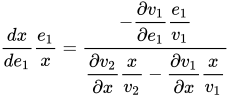
{\displaystyle {\frac {dx}{de_{1}}}{\frac {e_{1}}{x}}={\frac {-{\dfrac {\partial v_{1}}{\partial e_{1}}}{\dfrac {e_{1}}{v_{1}}}}{{\dfrac {\partial v_{2}}{\partial x}}{\dfrac {x}{v_{2}}}-{\dfrac {\partial v_{1}}{\partial x}}{\dfrac {x}{v_{1}}}}}}

The scaled derivatives on the right-hand side are the elasticities, {\displaystyle \varepsilon _{x}^{v}} and the scaled left-hand term is the scaled sensitivity coefficient or concentration control coefficient, {\displaystyle C_{e}^{x}}

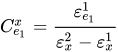
{\displaystyle C_{e_{1}}^{x}={\frac {\varepsilon _{e_{1}}^{1}}{\varepsilon _{x}^{2}-\varepsilon _{x}^{1}}}}

We can simplify this expression further. The reaction rate v_{1} is usually a linear function of e_{1}. For example, in the Briggs–Haldane equation, the reaction rate is given by {\displaystyle v=e_{1}k_{cat}x/(K_{m}+x)}. Differentiating this rate law with respect to e_{1} and scaling yields: {\displaystyle \varepsilon _{e_{1}}^{v_{1}}=1}.

Using this result gives:

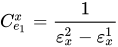
{\displaystyle C_{e_{1}}^{x}={\frac {1}{\varepsilon _{x}^{2}-\varepsilon _{x}^{1}}}}

A similar analysis can be done where e_{2} is perturbed. In this case we obtain the sensitivity of x with respect to e_{2}:

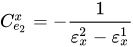
{\displaystyle C_{e_{2}}^{x}=-{\frac {1}{\varepsilon _{x}^{2}-\varepsilon _{x}^{1}}}}

The above expressions measure how much enzymes e_{1} and e_{2} control the steady state concentration of intermediate x. We can also consider how the steady state reaction rates v_{1} and v_{2} are affected by perturbations in e_{1} and e_{2}. This is often of importance to metabolic engineers who are interested in increasing rates of production. At steady state the reaction rates are often called the fluxes and abbreviated to J_{1} and J_{2}. For a linear pathway such this example, both fluxes are equal at steady state so that the flux through the pathway is simply referred to as J. Expressing the change in flux as a result of a perturbations in e_{1} and taking the limit as before we obtain:

{\displaystyle C_{e_{1}}^{J}={\frac {\varepsilon _{x}^{1}}{\varepsilon _{x}^{2}-\varepsilon _{x}^{1}}},\quad C_{e_{2}}^{J}={\frac {-\varepsilon _{x}^{1}}{\varepsilon _{x}^{2}-\varepsilon _{x}^{1}}}}

The above expressions tell us how much enzymes e_{1} and e_{2} control the steady state flux. The key point here is that changes in enzyme concentration, or equivalently the enzyme activity, must be brought about by an external a


This article uses material from the Wikipedia article
 Metasyntactic variable, which is released under the 
Creative Commons
Attribution-ShareAlike 3.0 Unported License
.