Steroid 21-hydroxylase, also called steroid 21-monooxygenase,[1] 21α-hydroxylase,[2] and, less commonly, 21β-hydroxylase,[3][4] is an enzyme that hydroxylates steroids at the C21 position[5][6] and is involved in biosynthesis of aldosterone and cortisol. The enzyme converts progesterone and 17α-hydroxyprogesterone into 11-deoxycorticosterone and 11-deoxycortisol, respectively.[7][8] The products of the conversions then continue through their appropriate pathways towards creation of aldosterone and cortisol. The enzyme is localized in endoplasmic reticulum membranes of adrenal cortex,[9][10] and is encoded by CYP21A2 gene in humans.
Function
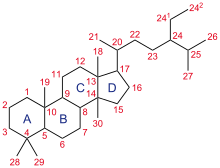
The steroid 21-hydroxylase (or simply 21-hydroxylase) enzyme is called this way because it hydroxylates steroids at the C21 position.[8] The enzyme catalyzes the chemical reaction in which the hydroxyl group (-OH) is added at the C21 position of the steroid biomolecule. The enzyme is a member of the cytochrome P450 superfamily of monooxygenase enzymes. The cytochrome P450 enzymes catalyze many reactions involved in drug metabolism and synthesis of cholesterol, steroids and other lipids. 21-hydroxylase is localized in microsomes of endoplasmic reticulum membranes within adrenal cortex. It is one of three microsomal steroidogenic P450 enzymes, the others being 17-hydroxylase and aromatase.[11]
21-hydroxylase is an essential enzyme in the biosynthetic pathways that produce cortisol and aldosterone.[12][13]
Structure
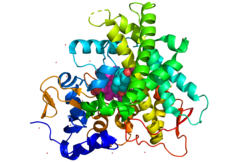
21-hydroxylase is a complex of three independent and identical enzyme subunits. Each subunit in the human enzyme consists of 13 α-helices and 9 ß-strands, formed into a triangular prism-like tertiary structure.[7] The iron(III) heme group that defines the active site resides in the center of each subunit. The human enzyme binds one substrate at a time.[7] In contrast, the well-characterized bovine enzyme can bind two substrates.[14] The human and bovine enzyme share 80% amino acid sequence identity, but are structurally different, particularly in loop regions, and also evident in secondary structure elements.[7]
Reaction
21-Hydroxylase catalyzes the addition of hydroxyl (-OH) to the C21 position of two steroids: progesterone and 17α-hydroxyprogesterone. This reaction was first described in 1952.[15]


Mechanism
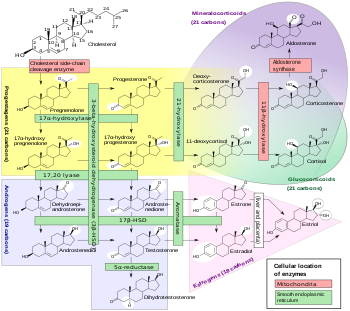

21-Hydroxylase is a cytochrome P450 enzyme and follows the P450 catalytic cycle.
21-Hydroxylase is highly specific for hydroxylation of progesterone and 17-hydroxyprogesterone. This is in marked contrast to the evolutionarily and functionally related P450 enzyme 17-hydroxylase, which has a broad range of substrates.[16]
Earlier studies of the human enzyme expressed in yeast classified 17-hydroxyprogesterone as the preferred substrate for 21-hydroxylase.[16][17][18] However, more recent analysis of the purified human enzyme found a lower KM and greater catalytic efficiency for progesterone over 17-hydroxyprogesterone.[7]
The catalytic efficiency of 21-hydroxylase for conversion of progesterone in humans is approximately 1.3 x 10^7 M-1s-1 at 37 °C. This makes it the most catalytically efficient P450 enzyme of those reported to date, and catalytically more efficient than the closely related bovine 21-hydroxylase enzyme.[9] C-H bond breaking to create a primary carbon radical is thought to be the rate-limiting step in the hydroxylation.[7]
Like other cytochrome P450 enzymes, 21-hydroxylase participates in the cytochrome P450 catalytic cycle and engages in one-electron transfer with NADPH-P450 reductase. Its structure includes an essential iron heme group centered within the protein, also common to all P450 enzymes. Variations of the 21-hydroxylase enzyme can be found in all vertebrates.[19] However, understanding of human 21-hydroxylase structure and function is of particular clinical value, as a failure of the enzyme to act appropriately results in congenital adrenal hyperplasia. The X-ray crystal structure for human 21-hydroxylase, with bound progesterone, was realized and published in 2015, providing opportunity for further study.[7] The enzyme is notable for its substrate specificity and relatively high catalytic efficiency.
Genetics



Location
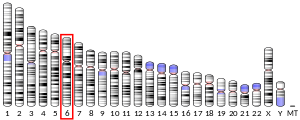
21-hydroxylase is a protein encoded by CYP21A2 gene in humans. A related pseudogene, CYP21A1P, is located near this gene.[24] Both genes are located on chromosome 6, in the major histocompatibility complex III[25] close to the Complement component 4 genes C4A and C4B, the Tenascin X gene TNXB and STK19,[26] and the pseudogene, CYP21A1P, retains 98% exonic sequence identity with the functional gene CYP21A2.[27]
In the mouse genome, the CYP21A2 is a pseudogene and the CYP21A1 is a functional gene.[28] In the chicken and quail, there is only a single CYP21 gene, which locus is located between complement component C4 and TNX gene, along with CENPA.[29]

Role in the human major histocompatibility complex
MHC class III is a group of proteins belonging to the class of major histocompatibility complex (MHC).[25] Unlike other MHC types such as MHC class I and MHC class II, of which their structure and functions in immune response are well defined, MHC class III are poorly defined structurally and functionally. It covers 700 kb and contains 61 genes, making it the most gene-dense region of the human genome.[30] The functions of many genes are yet unknown.
The CYP21A2 gene travels in tandem with a pseudogene, CYP21P1, and the high degree of sequence similarity between them indicates that these two genes are evolving in tandem through intergenic exchange of DNA.[31] The CYP21A2 gene is located within the RCCX cluster, which is the most complex gene cluster in the human genome.[32] Due to the high degree of homology between the CYP21A2 gene and the CYP21P1 pseudogene and the complexity of the locus, it is difficult to study the CYP21A2 gene at the molecular level.[33]
Clinical significance
Congenital adrenal hyperplasia
Genetic variants in the CYP21A2 gene cause a disturbance of the development of the enzyme, which may lead to congenital adrenal hyperplasia due to 21-hydroxylase deficiency. A related pseudogene CYP21A1 is located near this gene. Gene conversion events involving the functional gene and the pseudogene are thought to account for many cases of steroid 21-hydroxylase deficiency.[5] Congenital adrenal hyperplasia (CAH) is an autosomal recessive disorder. There are multiple forms of CAH, broken down into classical and nonclassical forms based on the amount of function retained. The classical forms occurs in approximately 1 in 15000 births globally,[34][35] and include salt-wasting (SW), and simple-viralizing (SV). Mutations that interfere with the active site—the heme group or residues involved in substrate binding—result in a complete loss of enzymatic activity, the salt-wasting type.[36] Studies have shown that mutations in the structure of 21-hydroxylase are related to the clinical severity of congenital adrenal hyperplasia.[37] Cortisol and aldosterone deficits are associated with life-threatening salt-loss (hence salt-wasting), as the steroids play roles in regulating sodium homeostasis. Retaining minimal enzyme activity, the simple-viralizing type is associated with mutations in conserved hydrophobic regions or near the transmembrane domain. Simple-viralizing CAH patients maintain adequate sodium homeostasis, but exhibit other phenotypical symptoms shared by SW, including accelerated growth in childhood and ambiguous genitalia in female neonates. Nonclassical forms retain 20-60% of hydroxylase function—this form is associated with normal cortisol expression, but an excess of androgens post-puberty.[38][39]
Non-classic congenital adrenal hyperplasia
Non-classical congenital adrenal hyperplasia caused by 21-hydroxylase deficiency (NCCAH) is a milder and late-onset congenital adrenal hyperplasia. Its prevalence rate in different ethnic groups varies from 1:1000 to 1:50.[13][40] Some people affected by the condition have no relevant signs and symptoms, while others experience symptoms of hyperandrogenism. Women with NCCAH usually have normal female genitalia at birth. In later life, the signs and symptoms of the condition in women may be different, but may include acne, hirsutism, male-pattern baldness, irregular menstruation, and infertility.[13][41][42] Fewer studies have been published about males with NCCAH comparing to those about females, because males are generally asymptomatic.[42][13] Males may have early beard growth and relatively small testes. Typically, they have normal sperm counts.[42]
| This article uses material from the Wikipedia article Metasyntactic variable, which is released under the Creative Commons Attribution-ShareAlike 3.0 Unported License. |